
A forward deployed engineer (FDE) is a software engineer embedded directly inside a customer’s environment to build and ship production code that makes an AI or software product actually work on that customer’s data and systems. The role sits between engineering and consulting: FDEs write real code, but they do it on-site, in front of the client, under live deployment pressure.
Demand for the role grew over 1,000% year-over-year, and total compensation at frontier labs like Anthropic and OpenAI now runs from $385K at mid-level to over $1M at principal level, per 2026 forward deployed engineering compensation data.
Palantir invented the role two decades ago to solve one problem: a demo wins the meeting, but a working deployment wins the contract. Here is the hard truth most job seekers miss: the FDE boom is not really about engineering talent. It is about the fact that AI has made code cheap and judgment expensive, and companies are paying seven figures for the few people who can bridge that gap in the room, live, with a client watching.
The Build Order Before The Attack
In Warcraft, you do not win by rushing units into the enemy base. You scout, you manage resources, you pick your build order, and only then do you attack, because the player who commits troops before understanding the terrain loses them for nothing. Enterprise AI deployment works the same way. Companies that ship a model straight into a client’s messy data pipeline without someone scouting the terrain first lose the deal, not the war, but the war matters less if you lose every battle. The forward deployed engineer is the scout and the shock troop combined: sent ahead of the main product team to map the client’s actual infrastructure, then build the fix live before the opponent, meaning the sales cycle, runs out the clock.
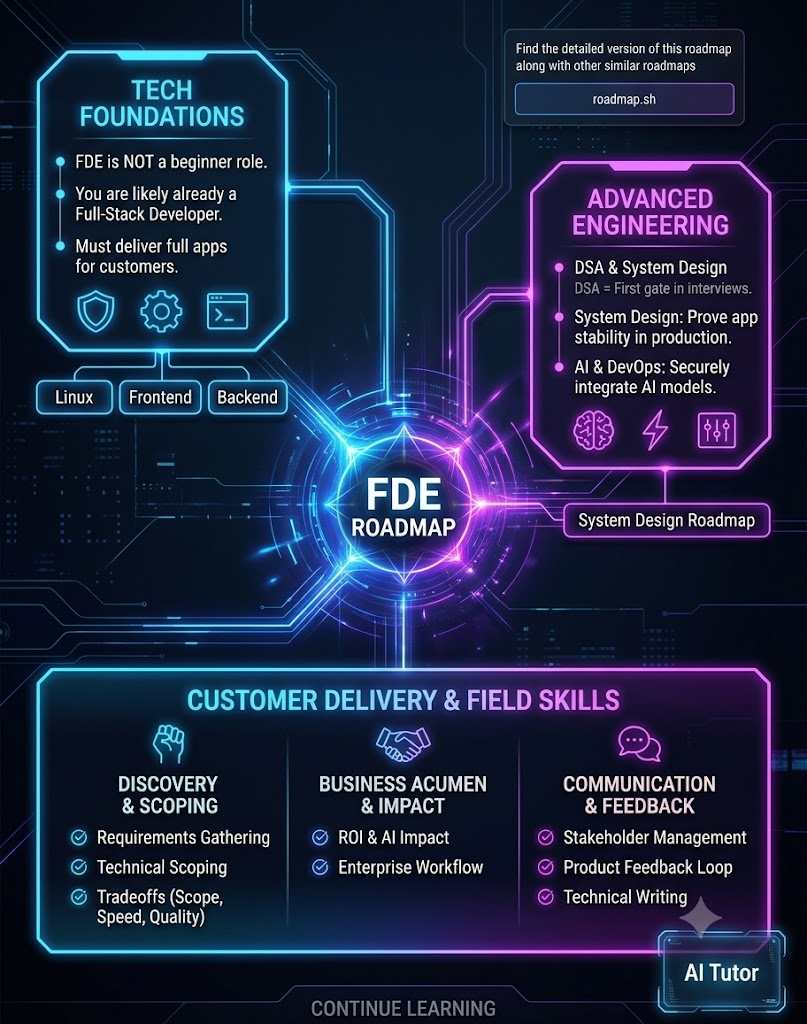
What A Forward Deployed Engineer Actually Does
A forward deployed engineer writes production-grade code inside a client’s environment to solve that specific client’s deployment problem. The job is not a demo job. FDEs are expected to write and review real backend and frontend code, integrate with a customer’s existing systems, and fix reliability or security issues live, on-site.
This is not a rebrand of « solutions engineer. » A solutions engineer works mostly pre-sale: discovery calls, proof-of-concept demos, architecture reviews. Per Paraform’s 2026 role comparison, FDEs skew deep and technical while solutions engineers skew broad and persuasive. The FDE shows up after the contract is signed and stays until the thing actually runs on the client’s data, which is a different job with a different skill floor.
Most postings ask for 5+ years of engineering experience, comfort with both frontend and backend production code, and tolerance for travel that can hit 50% of the role. Palantir built this model in the 2000s for government and defense clients who could not simply « buy software off the shelf. » Twenty years later, AI labs hit the identical wall: a chatbot demo is trivial, but making that same model reliably parse a hospital’s decade of unstructured records is not, and no amount of marketing closes that gap.
The provocation: if your product needs an engineer physically embedded to make it work, your product is not finished, it is a beta with a sales team attached.
Why Demand Exploded 10x In Eighteen Months
Forward deployed engineer job postings grew 1,165% year-over-year, according to 2026 hiring data tracked across AI labs and enterprise software firms. Roughly 8,500 new FDE roles opened in the US between 2023 and 2025 alone.
The reason is structural, not a hiring fad. Frontier labs like OpenAI, Anthropic, and Mistral discovered that a model impressive enough to win a Fortune 500 pilot is not automatically capable of running inside that company’s actual tech stack, security constraints, and legacy data formats. Palantir, Salesforce, Snowflake, ServiceNow, and Oracle are now hiring the same profile for the same reason: enterprise software sells on the demo and dies on the deployment.
2026 hiring trackers count 224 open FDE roles across 118 companies, spanning frontier AI labs to legacy enterprise vendors. This is not a niche title anymore. It is becoming the default hire for any company selling AI into companies that were not born after 2020.
The provocation: every company chasing an FDE hiring spree is quietly admitting its core product cannot sell itself.
What Forward Deployed Engineers Actually Earn In 2026
Compensation for FDEs varies by roughly 5x depending on which tier of company is hiring. The general market median base salary sits at $210K, with the 25th percentile at $165K and the 75th at $243K, based on a 2026 sample of 44 tracked roles.
At frontier labs, the numbers change category entirely. Mid-level FDEs at Anthropic or OpenAI now average $385K in total compensation, staff-level hits $610K, and principal-level packages exceed $1M, driven overwhelmingly by equity. Palantir itself sits closer to the market median, around $215K total comp, while senior frontier-lab packages run north of $785K.
| Tier | Level | Total Comp (2026) |
|---|---|---|
| Market median (all companies) | Mid-level | $210K |
| Palantir | Mid-level | ~$215K |
| Frontier labs (OpenAI, Anthropic) | Mid-level | $385K |
| Frontier labs | Staff | $610K |
| Frontier labs | Principal | $1.0M+ |
The gap between « market FDE » and « frontier lab FDE » is not a 20% premium. It is a different job wearing the same title, and treating them as interchangeable in a salary negotiation is the fastest way to leave $150K on the table.
The provocation: the title on the job posting tells you almost nothing about the paycheck. The company tier tells you everything.
The Skill That Actually Gets You Hired
Writing code is no longer the scarce skill in this role, and that is the part most candidates prepare for wrong. AI has collapsed the cost of implementation. What has not gotten cheaper is knowing what is worth implementing in the first place, which is a consultant’s instinct, not a coder’s.
The FDEs commanding frontier-lab comp are not the fastest typists in the room. They are the ones who can sit in a client meeting, understand within twenty minutes what the client’s actual bottleneck is versus what the client thinks it is, and then prototype a fix on the spot using AI tools, in that same meeting, before the client has finished explaining the problem. That compressed loop, diagnosis to working prototype in one sitting, is what companies are paying seven figures to acquire.
Solutions engineers still win on a different axis: they handle live executive-level scope negotiation and translate technical constraints for non-technical stakeholders, a skill built over years that FDE hiring pipelines cannot manufacture in engineers who have never done client-facing work.
The provocation: if your pitch as a candidate is « I can code fast, » you are competing against a model that codes faster than you for free. The job is not open to fast coders anymore. It is open to people who know which problem is real.
How To Actually Break Into The Role
Getting hired as a forward deployed engineer starts with proving deployment judgment, not interview-style algorithm skills. Most FDE interview loops now include a live scenario: here is a messy dataset, here is a vague client complaint, build something in the next hour that addresses the real problem, not the stated one.
Three things move the needle for candidates in 2026. First, build a portfolio of messy, real-world integration work, not clean side projects. Hiring managers at frontier labs specifically look for engineers who have shipped something into an environment they did not control, because that is the actual job. Second, get comfortable narrating your reasoning out loud while you work, since FDE interviews increasingly score how you think under ambiguity, not just what you produce. Third, target the tier deliberately. A market-rate FDE role at a mid-size enterprise vendor and a frontier-lab FDE role at Anthropic or OpenAI share a job title and almost nothing else in comp, travel load, or technical bar, so applying without knowing which tier you are aiming for wastes months.
Recruiters tracking the space note that referrals matter more here than in typical engineering hiring, because the pool of engineers who can demonstrate both production coding chops and live client judgment is still genuinely small relative to the 224 open roles counted across 118 companies in 2026. That scarcity is precisely why the comp curve is this steep, and it will likely stay steep until business schools and bootcamps catch up with a curriculum built for this specific hybrid skill set, which as of mid-2026 does not really exist yet.
The provocation: most engineers are still optimizing their LeetCode reps for a job that will test their judgment in a room, not their recall at a whiteboard.
The Part Nobody Puts In The Job Posting
Sustainability on this role is shaky, and the honest data backs that up. Travel routinely runs a quarter to half of the job depending on the account. Strong performers get rewarded with the hardest, most fire-prone deployments, which means the better you are at this job, the more of the worst version of it you get handed.
There is a deeper structural risk too: some companies use FDEs as a permanent human patch for a product that was never actually finished. Instead of fixing the platform, they keep sending embedded engineers to firefight the same category of problem client after client, which is expensive heroics dressed up as a career path. That pattern produces burnout fast, and it produces zero durable product improvement, because every fix stays bespoke to one client instead of becoming a real feature.
Whether the trade is worth it depends entirely on what you want from your 20s and 30s. If you want ownership, high variance, and the pay that comes with both, the role delivers. If you want predictable hours and scoped work, this is the wrong door.
Forward Deployed Engineer vs. Solutions Engineer vs. Consultant
| Dimension | Forward Deployed Engineer | Solutions Engineer | Traditional Consultant |
|---|---|---|---|
| When they engage | Post-sale, during deployment | Pre-sale, during the pitch | Pre- and post-sale, advisory |
| Core output | Production code, live | Demos, POCs, architecture | Recommendations, playbooks |
| Coding depth | Deep, hands-on | Moderate, demo-grade | Usually none |
| Client-facing skill | Diagnostic, technical | Persuasive, executive-facing | Strategic, relationship-driven |
| Compensation ceiling (2026) | $1M+ at frontier labs | Lower, sales-commission-linked | Partner-track, slower ramp |
FAQ
Q: Is a forward deployed engineer job actually worth it?
A: It depends on your tolerance for travel and ambiguity. FDEs at frontier labs earn some of the highest total comp in tech, but the role demands frequent on-site work, unscoped problems, and being the person accountable when a deployment breaks in production. For engineers who want ownership and pay over predictability, yes. For those who want bounded hours, no.
Q: Why do companies suddenly need so many forward deployed engineers?
A: Because AI models that impress in a demo frequently fail to run reliably inside a client’s actual data environment, and no amount of sales effort fixes that gap. FDEs exist to close it in real time, which is why postings grew over 1,000% year-over-year through 2026.
Q: What is the difference between a forward deployed engineer and a solutions engineer?
A: An FDE writes and ships production code inside the client’s live environment after the sale closes. A solutions engineer builds demos and proves technical fit before the sale, and rarely touches production systems.
Q: How much does a forward deployed engineer make in 2026?
A: Market median total comp is around $210K. At frontier AI labs like OpenAI and Anthropic, mid-level FDEs average $385K, staff-level $610K, and principal-level exceeds $1M, mostly through equity.
Q: Do you need to know how to code to become a forward deployed engineer?
A: Yes, but coding speed is no longer the differentiator since AI tools have made implementation cheap. What gets you hired now is the ability to diagnose the client’s real problem fast and prototype a fix live, in the room.
Q: Why do most engineers get the forward deployed engineer role wrong when they apply?
A: They prepare like it is a coding interview. It is closer to a live consulting audition. Hiring teams are testing judgment under ambiguity, not algorithm recall.
Q: Is forward deployed engineering a stable long-term career?
A: Not universally. Some organizations use FDEs as a permanent patch for an unfinished product, which creates burnout without building anything durable. Vet the company’s product maturity before you vet the comp package.
The Verdict
The forward deployed engineer boom is not a talent story, it is a confession: most AI products still cannot survive contact with a real client’s infrastructure without a human standing next to them. That gap is where the seven-figure packages live, and it will keep paying well until AI products get good enough to deploy themselves, at which point the FDE either becomes the person who builds that self-deploying layer or gets replaced by it.
If you are weighing this path, or hiring for it, stop optimizing for coding speed and start proving you can diagnose a real problem in a room in twenty minutes, because that is the actual audition now. Rémy Bigot goes deeper on exactly why this role is exploding, what it signals about the next two years of AI hiring, and how to position yourself before the market catches up, in this full breakdown of the FDE metier explosion. It is the sharpest read available right now on where this specific job goes next. Worth five minutes before your next interview, hiring decision, or career pivot.