
Executive Summary (The TL;DR)
If you have raised $10M in institutional seed funding and your primary operational headache is Web3 compliance or setting up a Family Office, go to Singapore.
If you are a lean, high-ticket founder, building automated AI systems, or scaling an authority-driven consulting business, moving to Singapore in 2026 is financial suicide driven by vanity.
After three years in Indonesia, my wife and I needed a permanent Asian headquarters.
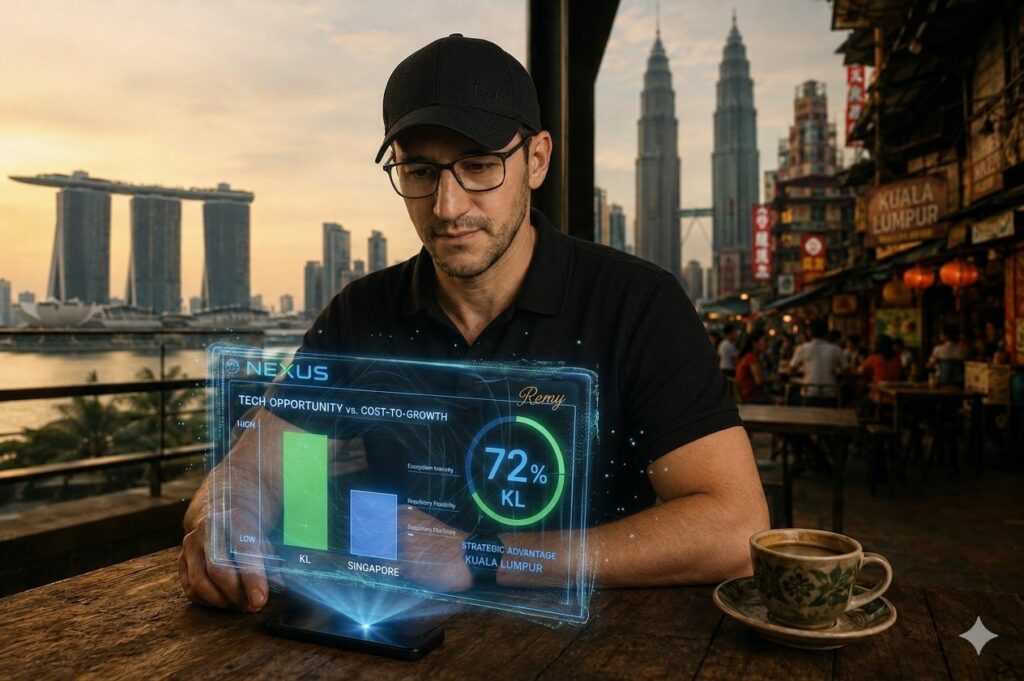
To bypass my own Western biases, I fed the macro-economic data, visa frameworks, and talent costs of both cities into asymmetriq—my custom AI strategy agent.
The engine returned a definitive score: Kuala Lumpur offers a 72% higher « Cost-to-Growth » advantage.
Here is the unvarnished math, the geopolitical reality, and the operating thesis behind that score.
1. The Macro View: The « Backend of Asia » Thesis
Most business comparisons between Singapore and Malaysia treat them as isolated islands. This ignores the single biggest economic tectonic shift of our decade: the US-China semiconductor decoupling.
When Washington banned the export of advanced AI chips to Beijing, it created a massive, urgent demand for « neutral ground » infrastructure. Look at where the real capital is flowing:
- Nvidia is building a $4.3 Billion AI infrastructure hub in Malaysia (partnering with YTL Power).
- Intel has poured over $7 Billion into advanced chip packaging in Penang and Kulim.
- AWS is executing a $6 Billion infrastructure rollout across the country.
Singapore is the front-office of Southeast Asia—the place where the holding companies sit, the contracts are signed, and the wealth is parked. But Malaysia is rapidly becoming the back-office of the global AI boom.
By planting your flag in Kuala Lumpur, you aren’t moving to a « cheaper alternative »; you are positioning yourself upstream in the exact supply chain where the compute, the data centers, and the raw engineering talent are being concentrated.
2. The Hard Data: A Side-by-Side Reality Check
Founders love to talk about « vibes. » Systems run on unit economics. When we strip away the PR of the Singapore Economic Development Board, the side-by-side operational ledger looks like this:
| Metric | Singapore (SG) | Kuala Lumpur (MY) | The Arbitrage Delta |
| Prime Office / Living (100m²) | ~$5,800 / mo (Marina Bay) | ~$1,150 / mo (KLCC / Mont Kiara) | 5.0x cheaper |
| Senior ML / Python Engineer | ~$95,000 / year | ~$28,000 / year | 3.3x cheaper |
| Corporate Tax Rate | 17% (Flat) | 24% (Down to 0-5% via MDEC) | Massive structural edge |
| Tech Visa Friction | Extreme (EP: min $5k/mo baseline) | Low (DE Rantau / MDEC Tech Pass) | Months vs. Weeks |
| Runway on a $250k Budget | ~8 Months | ~26 Months | +225% survival time |
The « Malaysia Digital » Tax Trojan Horse
Most basic Google searches will tell you Malaysia taxes corporations at 24% versus Singapore’s 17%. This is a rookie trap.
If you are an AI, software, or tech-consulting founder, you apply for Malaysia Digital (MD) Status via the MDEC (Malaysia Digital Economy Corporation). Once granted, your tech-derived income can be subjected to tax exemptions ranging from 0% to 5% for up to 10 years, alongside zero restrictions on foreign equity. You get a lower effective tax rate than Singapore, at one-fifth of the operational overhead.
3. Deconstructing the Singapore Fortress
Singapore is a masterpiece of urban engineering. It is safe, impeccably clean, and operates with the precision of a Swiss watch. But it suffers from The Prestige Trap.
In Singapore, your burn rate is aggressive before you even open your laptop. A standard cup of specialty coffee, a decent desk at a Tier-1 co-working space, and the mandatory local corporate secretary will quietly bleed $3,000 a month from your treasury.
Because the cost of living is so violently high, you cannot afford to be patient.
- In Kuala Lumpur, if a new high-ticket AI consulting offer takes 4 months to find its product-market fit, you lost $10,000 of personal runway.
- In Singapore, that same 4-month pivot costs you $45,000.
Singapore forces you to hunt for immediate, short-term cash flow to feed the machine. Kuala Lumpur buys you the ultimate luxury an early-stage strategist can possess: Time to think.
4. Inside the Hood: The ‘asymmetriq’ Scoring Algorithm
To keep myself honest, I programmed asymmetriq to evaluate both cities across five weighted vectors. I didn’t ask it « Where will I be happier? » I asked it: « Where does a lean AI consultancy achieve the highest enterprise value per dollar spent? »
The formula used:
$$\text{Score} = (W_1 \times \text{Runway}) + (W_2 \times \text{Talent}) + (W_3 \times \text{Macro}) – (W_4 \times \text{Friction})$$
- Vector 1: Capital Efficiency & Runway (Weight: 30%) — Winner: Kuala Lumpur (9.5/10). The 5x housing arbitrage and low consumer inflation give an immediate structural floor to the business.
- Vector 2: Talent Arbitrage (Weight: 25%) — Winner: Kuala Lumpur (8.0/10). While Singapore has the elite « Head of AI » tier, KL possesses an ocean of hungry, English-speaking mid-level developers graduating from APU and UM, billable at a fraction of Western rates.
- Vector 3: Geopolitical Resilience (Weight: 20%) — Tie (8.5/10). Both are non-aligned safe havens, but Malaysia’s physical control over the Malacca Strait and deep-water energy grids gives it an edge in heavy compute infrastructure.
- Vector 4: Administrative Velocity (Weight: 15%) — Winner: Kuala Lumpur (9.0/10). As a French citizen married to an Indonesian national, Singapore’s Family Dependant Pass quotas are an absolute bureaucratic nightmare. Malaysia recognized the marriage and issued a long-term residency framework in a matter of weeks.
- Vector 5: The « Organic Friction » Index (Weight: 10%) — Winner: Kuala Lumpur (9.0/10). (See below).
Final Output: Kuala Lumpur 72.4% / Singapore 27.6%
5. The Qualitative Truth: « Building in the Friction »
When asymmetriq spit out the 72% figure, it appended a qualitative note generated from my past journal entries:
« Rémy, Singapore is an air-conditioned terrarium. Kuala Lumpur is a jungle. In a terrarium, everything is provided for you, but your growth is strictly capped by the size of the glass. In the jungle, it’s humid, it’s a bit chaotic, but the ceiling is the open sky. »
It hit the nail on the head. Singapore is so polished that it feels finished. When an environment is completely finished, it induces a weird complacency. You feel like an observer in an expensive museum.
Kuala Lumpur possesses a raw, vibrating, « controlled chaos. » You look out the window of a high-tech skyscraper in Bangsar South, and down on the street, an old uncle is frying Char Kway Teow in a wok over an open flame. It feels real. It reminds me of the slightly messy, highly alive neighborhoods of my childhood in France.
Innovation doesn’t happen in sterile, sanitized rooms. It happens where different socio-economic realities rub against each other. It happens in the friction.
I don’t want to live in the lobby of a 5-star hotel. I want to be in the workshop.
KL, let’s build.
Deep-Dive FAQ
Q: What is the « DE Rantau » pass, and is it viable for serious founders?
A: Yes. Unlike standard « Digital Nomad » gimmicks in Europe, Malaysia’s DE Rantau Nomad Pass specifically targets IT, AI, and digital marketing professionals. It grants you up to 24 months of legal residency, allows you to bring your spouse, and requires a very accessible provable income threshold ($24,000/year). It is the ultimate bridge pass while you set up your formal Malaysian Sdn Bhd (LLC).
Q: Won’t my clients perceive a Kuala Lumpur entity as « less professional » than a Singaporean one?
A: In 2016? Yes. In 2026? Completely irrelevant. High-ticket B2B clients buy authority, clear systems, and speed of execution. If your payment infrastructure is clean (you can route a KL company through a Wise Business or a US LLC for invoicing), a client in Paris, New York, or Tokyo does not care where your physical desk sits.
Q: How does the talent pool in KL actually compare to Europe or SG?
A: The top 5% of engineers in Singapore are better than the top 5% in KL—they are Stanford and Tsinghua grads brought in by Grab and Sea Group. However, the top 20% in KL are fundamentally superior to the average European developer in one crucial aspect: Hunger. Malaysian devs work in the Asian time zone rhythm, speak fluent business English, and are aggressively upskilling on LLM orchestration to catch the global wave.
Q: What is the biggest hidden downside of Kuala Lumpur?
A: Pedestrian infrastructure and the banking setup. You cannot walk anywhere in KL; it is a city built for cars and Grab rides. Secondly, while opening a bank account in Singapore takes 48 hours via a sleek app, opening a corporate account at Maybank or CIMB in Malaysia involves physical paperwork, wet-ink signatures, and a level of bureaucracy that will test your patience. Optimize for it: hire a local fixer.
Rémy Bigot is the founder of RemyAI. He builds AI systems for high-performing executives and documents the geopolitics of the future of work. [Click here to get his weekly strategic briefings].